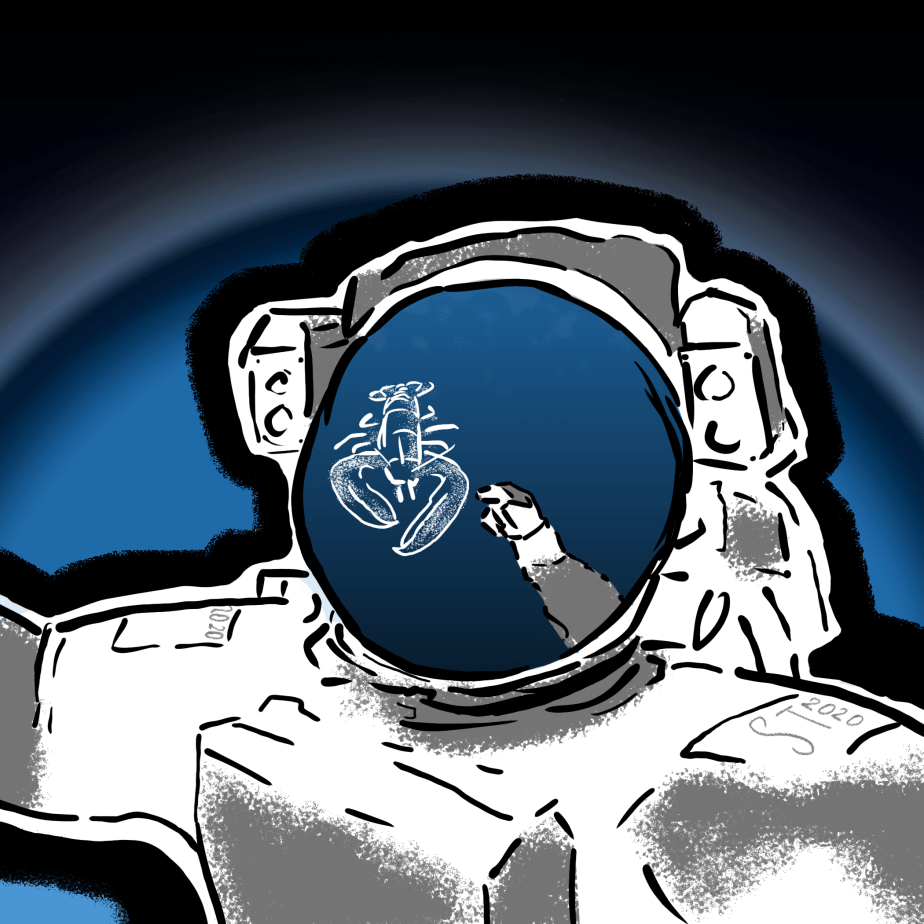
I know that this title fits right in with “The Walrus and the Carpenter” by Lewis Carroll, but I recently learned of an intriguing connection between lobsters and astronauts.
The time has come,’ the Walrus said,
To talk of many things: of shoes – and ships – and sealing wax –
of cabbages – and kings –
And why the sea is boiling hot –
And whether pigs have wings.’ - Lewis Carroll
Just a few days ago, I watched live as the SpaceX NASA flight to the International Space Station went without a hitch. It is amazing that technology has come so far that a mission like this has become nearly commonplace. We are nearing the point in history where lunar and Martian colonies are about to become reality, and I look forward to seeing this happen in my lifetime.
In October, the International Space Station reached its 20-year anniversary. This milestone means that there have been humans living in space for two decades! Not only is this an amazing feat of science and engineering, it is a testament to the teamwork and ingenuity of the astronauts who have had to patch up their fragile home orbiting Earth.

I learned a lot from an interesting National Geographic article, “Humans have been living in space for 20 years straight,” by Michael Greshko. It follows the timeline from the first few astronauts and cosmonauts on the International Space Station in 2000, through some of the challenges and breakthroughs, to more recent crews and NASA’s Twin Study. I find space travel fascinating and admire the innovation and bravery of astronauts (and of course the countless engineers and mathematicians that get them into space!) This article reminded me of other stories I have read or watched, and the fun of connecting seemingly disparate points will make me remember this particular article for a while. One obvious connection was between seeing an image of astronauts preparing a meal and remembering an interview with the chefs who freeze-dry homemade food for the astronauts’ long journeys. Seeing images of astronauts floating around the ISS reminded me of videos I have seen about low-gravity research conducted on Earth, and how our brains adapt to new physical environments. Reading a mention of telomeres in the NASA Twin Study made me think about the oddball existence of lobsters, practically immortal thanks to their sturdy telomeres capping chromosomes, only dying when they don’t have the energy to grow a larger exoskeleton for themselves.
Telomeres are the endcaps on chromosomes, and once they wear out the chromosomes do too. This means a lot of research on lobsters has happened because people want to live longer, and lobsters naturally have a handy enzyme called telomerase that maintains their telomeres far beyond ordinary ones. We still have much to learn on our own planet as we plan on venturing to others. The NASA Twin Study had interesting results, but they aren’t conclusive by any means because one set of twins does not constitute a useful sample size. Greshko’s article mentioned several health risks astronauts face, and I have to say I’m glad I am staying in Earth’s gravity field.
Beyond the scientific trivia, I found this article about international crews working together inspirational because they have worked so hard to keep each other safe in their fragile environment. I had no idea how many things had gone wrong and been repaired out in orbit! I was impressed by the way Greshko could so effectively describe settings that most humans will never encounter. The ISS crews keep their home working smoothly as they orbit 254 miles above the planet. When viewing the Earth from above, there are no borders or divisions, and the ISS is a global effort unifying humanity. The continuous running of the International Space Station is a point of hope and strength standing in contrast to many situations in today’s world. These hard-working astronauts go through immense physical danger to help the rest of us learn more about science and are an amazing example of how people can work together in harmony.
Want to learn more?
 Sarah Turek Productions