After my whole research paper on the persuasive qualities of personalized shopping services, I had nearly convinced myself that Stitch Fix would be a fun experience. As it turned out, the personalization was hit or miss.
This past December, a YouTuber shared a link for $100 Stitch Fix credit. I jumped at the opportunity for free clothes and told several friends about it as well. I received a box of free clothes in the mail, tried them on, and kept one shirt. I was not disappointed in the fairly random assortment of clothes because it was only the first box.
When I received my first “Fix,” I was also able to share a $100 credit link with friends. I shared it briefly on my Instagram story, and a few friends used the link. This gave my Stitch Fix account $100 per new order, which gave me a grand total of $300 worth of credit to use. I was excited to see what my next Fixes had in store.
What I didn’t realize what that my frugal, thrift-store loving self would recoil at every ludicrous price. A blouse should not cost $50 in my humble opinion, nor should a pair of jeans cost $98. Maybe I was just raised to pay attention to prices and buy things on sale, but it went against my nature to accept the cost even using store credit. The clothes were of a nice quality, but it didn’t equate with the high prices to me.
My frustration was mainly due to the prices, but also due to the annoyingly baggy, loose tops that couldn’t technically be ruled as “not fitting” because they were oversized and one-size-fits-most. I am a very petite person, and I prefer more fitted formal clothes rather than oversized garments draping over me. No matter how many customizations I made to my customer account, I kept receiving baggy suit jackets in Fixes. Even when I asked my stylist to look at the notes I had left to explain what clothes I already had in my closet, I received more of the same – either clothes that absolutely didn’t fit, weren’t my style, or were things I already owned.
My biggest grievance was getting blazers without any clasp or button to fasten closed, after repeatedly explaining I didn’t want these sort of blazers.
I learned throughout this process that a personalized shopping service was not meant for me. I vastly prefer picking out my own purchases and getting to feel the fabric or try on clothes before purchasing them. I love the treasure-hunt aspect of browsing a thrift store. I understand that part of the Stitch Fix experience is to have a stylist pick out new clothes to complement your wardrobe, but I would have skipped the majority of what my stylists sent to me.
What you may not know if you are not a Stitch Fix customer is that each box has a styling fee – $20 per box, applicable to any items you purchase from that box. However, if you decide to return the box without keeping any clothes, you lose that $20 fee. This meant I felt forced to purchase a baggy sweater in order to not lose $20 of my credit. To be fair, it is a luxuriously soft sweater, and I might even wear it one day, but it isn’t really my style.
Finally, my Fix reviews had been poor enough that the system offered me another Fix without a styling fee.
“Excellent,” I thought, “If it’s all stuff I don’t want again, I can just return it and be done.”
Surprise: that is exactly what happened.
Somehow, the time I requested dresses and jumpsuits, they were completely out of stock in my size. The stylist for that Fix (they were different every time) recommended that I shop on the online Stitch Fix store to find dresses or jumpsuits when they were back in stock. With this advice, I used up the rest of my store credit on one dress and one jumpsuit. I ended up spending $2 of my own money to buy the $54 dress. Not a bad deal considering I had gotten what was listed as $300 worth of Stitch Fix merchandise.
The $54 dress
Was Stitch Fix worth it? To me, with the free credit, it was an interesting experience. I got some nice clothes, and realized that the customization and personalization sales pitch didn’t always live up to reality. Some of my friends got a few articles of clothing for free as well, which was nice. I have since gone back to my ways of buying clothes on sale, at thrift stores, and at garage sales. Just a day before writing this blog post, I bought a dress for fifty cents and altered it in about half an hour to fit me. That is much more my style (both fashion-wise and economically) than getting expensive clothes just for a specific brand or logo.
I can still see the persuasive appeals of Stitch Fix, but it’s just not aimed at me. I am not the target demographic because my spending habits don’t match their prices. Still, there are plenty of happy customers out there so the stylists must be doing something right.
Good news! You do not actually need to fake your death in order to start a new life on a tropical island.
Once you have cleared your celebratory confetti out of your eyebrows, let’s go over the many ways you can change your identity in the time-honored tradition of New Year’s.
The Extreme Exodus
If you move to a new place where nobody knows you, you can reveal as little about yourself as you please.
You can join new clubs, listen to new bands, and join a bowling league with a brand new nickname emblazoned on your team shirt. Your new coworkers might be intrigued by your mysterious past, or you can get creative using the backstory of a lesser-known fictional character. You can be honest about youself without revealing every last detail that your former peers knew.
The Pros: You can start a new life without faking your death. You will be able to start fresh and build a new identity. You get to wipe your social media clean or start new accounts. You can donate most of your current wardrobe and keep just a capsule wardrobe as a fashionable and eco-conscious newcomer to your chosen destination.
The Cons: You will have to un-tag yourself in a lot of social media posts to achieve anonymity in your new town. Depending on your new home, you may need to get rid a lot of your belongings.
Where to go: At least 3 hours of travelling distance from your current location, if not 3 states away. You don’t want to bump into any former acquaintances who will ask questions about your new nickname and hairdo. Think long and hard about where your friends and family are known to travel. Is it worth the risk living near that skiing resort in Colorado? Maybe a desert town will be desolate enough to avoid crossing paths, but then you could stand out as a newcomer. These vacation-worthy destinations are welcoming remote workers. Moving to another country will require a passport and visa with your current name, so plan accordingly.
1a. Aliases
Nicknames have already been mentioned. Do not force an unconvicing nickname like “Rocky” or “Flamingo” unless you bear a striking physical resemblance to the moniker. You can always legally change your name, but you have to tell all sorts of employers and officials about this change as you get the paperwork filed. Have a speedy and efficient getaway planned if you want to avoid any awkward questions, but make sure to follow all laws and regulations.
2. The Quick-Change Artist
This is a more common transformation observed throughout 2020-2021 as lockdown or quarantine boredom induced swathes of the population to dramatically change their physical appearances. You can change up your clothing style, hair color or style, accent, or even eye color if you are brave enough to wear contacts. (I am not. Good luck to you and your corneas.) With enough time and practice, you can effectively change your physical appearance to look like a video game character. They say to dress for the job you want, right?
The Pros: These are semi-permanent and easily reversed changes. It is fun and harmless unless you badly mess up while cutting your hair. The hair will grow back fairly quickly should you regret your decision, and you have lots of hat options in the meantime. You can experiment with fashion and get thrifted clothes, possibly learning valuable tailoring skills along the way.
The Cons: Hair dye can easily become face-and-hands dye, so wear gloves and be careful. Also, this could get expensive if you get carried away or if you need a professional to rescue your hair.
Things to Try: The least permanent hair option would be new hairstyles and hair chalk that washes out. Next up, a nice trim. Then…if you are confident in your choice, go for the haircut! Do make sure to look at examples and tutorials to confirm that your goal haircut works for your face shape. For clothes, I recommend upcycling and thrifting clothes unless there’s a specific item like a morph suit that you need to successfully greenscreen yourself like a chameleon.
3. The Apprentice
Get into a new hobby. Change up your routines and environment. Try following online dance tutorials, or yoga, but maybe not tap dancing if the clattering shoes will bother people nearby. (There are tutorials easily available online though!) Make something with your hands and set it on a shelf. Look at that thing you made! Learn a new recipe or invent your own. Maybe you’ll learn about chemistry while you’re at it! You can make things for your friends and neighbors and feel very self-reliant and accomplished as you gaze upon your table full of crafts and food. You don’t have to become an expert by any means. Actually, I think your real goal should be to learn and just have fun rather than focusing on having a productive or profitable skill.
The Pros: You will learn and make new things! You can cover upcoming holiday or birthday gift-giving with hobbies like candle-making, painting, drawing, and of course baking. You might discover a new talent or pasttime. There are all sorts of helpful tutorials and ideas for you to try out. You might achieve giving yourself a new reputation thanks to your nifty new hobby.
The Cons: If a particular hobby turns out to not be your thing, you might have a small pile of supplies left over that you no longer need. You can always pass these on to a friend or donate them, though.
Things to Try: Painting, drawing, candle-making, knitting, new video games, yoga, martial arts, learn the Charleston, tap-dancing, musical instruments or new vocal singing styles, paper quilling, card tricks, homemade icecream, cooking of all kinds, and biscuits or bread products in particular.
Change is Inevitable
If you don’t have any grand plans for the new year, that is totally fine. I went over the top in my silly identity-changing suggestions to illustrate how hardcore resolution-makers can seem like they are planning on closing the door on their “old life” just to coordinate with their new wall calendar. Monthly, smaller goals for better habits and self-improvement are more realistically attainable. I remember hearing in 7th grade that it takes 21 days to form a habit, so any time you want to make a change is a great time to do so. It doesn’t have to be a headlong sprint towards an impossible standard. Since things will inevitably change with the passage of time, you might as well pick a direction to drift.
Originally published in the Grace College newspaper Sounding Boardin October 2019.
Students Carry On with Stargazing Event Despite Weather
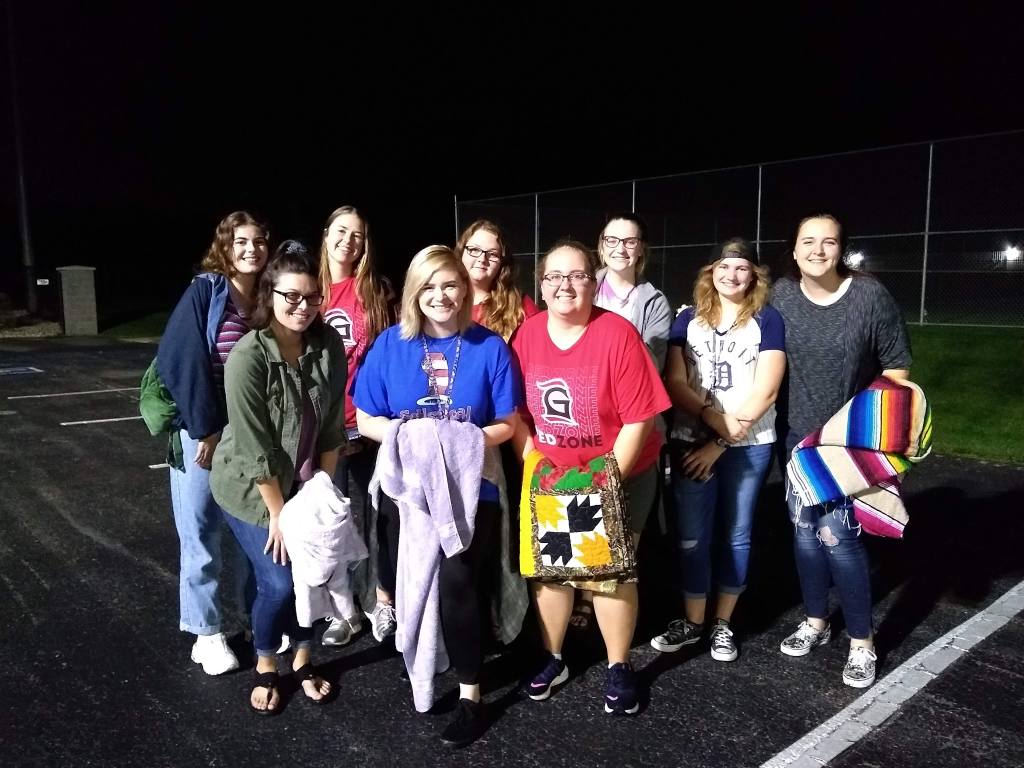
Westy 4 West’s growth group
By Sarah Turek
After the Lady Lancers won their Homecoming soccer game, dozens of students stayed after the game Wednesday night for a scheduled stargazing event. The rain did not keep the soccer players from peak performance during their game, but it did create a problem for the would-be stargazers. An overcast sky loomed over the students as they waited for the crowds to clear out. Many commented on the weather and expressed surprise that the event had not been called off. A handful of growth groups arrived, planning on spending their weekly meeting time out under the stars.
Initially, the students were not sure what to do or where to go. At the appointed time for the stargazing event to start, nobody in charge of the event had arrived. It seemed that the stargazing had been rained out, but no announcement had been made cancelling the event.
“I kept checking my email for a cancellation notice, but it never showed up,” a growth group leader mentioned.
A handful of students walked onto the soccer field, and a very confused staff member stuck his head out the press box’s window and said,
“I’m not sure you’re in the right place…”
“We aren’t either!” chorused several students cheerfully.
Suddenly, the students collectively remembered they were supposed to go to the practice field and began wandering over to set up. Amiably chatting, they headed to the practice field and spread out to sit with friends and growth groups.
Alpha 3 East’s growth group
“This is the coolest group on campus!” declared Jodi Flickery, wrapped in a blanket.
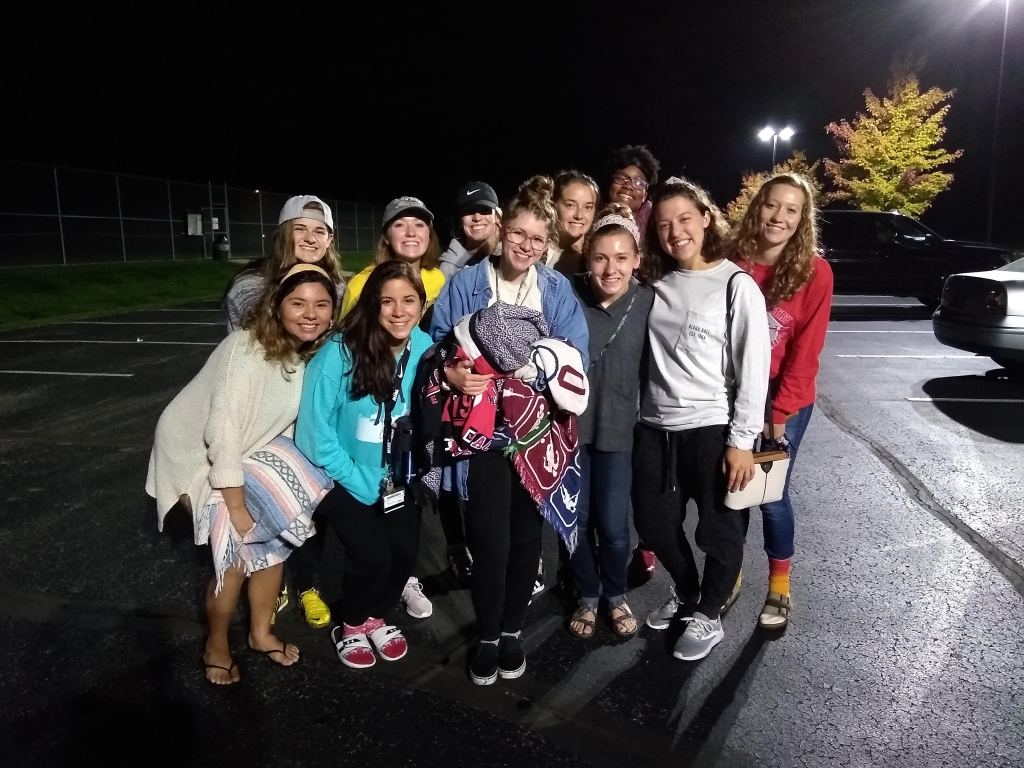
Nearly an hour later, about 24 students remained out on the dark field. Alpha 3 East and Alpha 2 East were having a great time hanging out with their growth groups. Despite the cloudy weather, these ladies were having fun listening to music, making star puns, and watching for the occasional breaks in cloud cover. One girl had a stargazing app on her phone, figuring out which constellations were behind various cloud formations.
“These are the real stars right here,” Caroline Jones said about her growth group.
Alpha 2 East’s growth group
As everyone gathered their blankets and headed back to their dorms, several girls commented that they found the time relaxing and that they’d like to go stargazing again when the skies were clear. If another stargazing event is scheduled in the future, there will definitely be many students happy to spend time together under the stars!
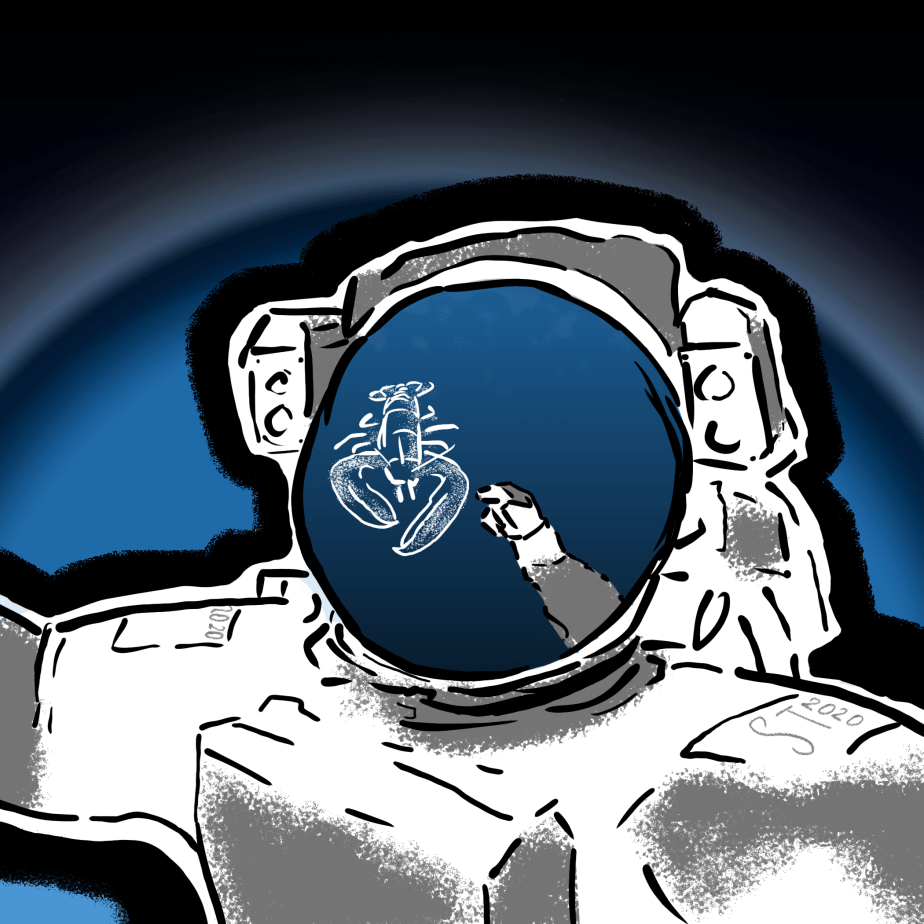
I know that this title fits right in with “The Walrus and the Carpenter” by Lewis Carroll, but I recently learned of an intriguing connection between lobsters and astronauts.
The time has come,’ the Walrus said,
To talk of many things: of shoes – and ships – and sealing wax –
of cabbages – and kings –
And why the sea is boiling hot –
And whether pigs have wings.’ - Lewis Carroll
Just a few days ago, I watched live as the SpaceX NASA flight to the International Space Station went without a hitch. It is amazing that technology has come so far that a mission like this has become nearly commonplace. We are nearing the point in history where lunar and Martian colonies are about to become reality, and I look forward to seeing this happen in my lifetime.
In October, the International Space Station reached its 20-year anniversary. This milestone means that there have been humans living in space for two decades! Not only is this an amazing feat of science and engineering, it is a testament to the teamwork and ingenuity of the astronauts who have had to patch up their fragile home orbiting Earth.
I learned a lot from an interesting National Geographic article, “Humans have been living in space for 20 years straight,” by Michael Greshko. It follows the timeline from the first few astronauts and cosmonauts on the International Space Station in 2000, through some of the challenges and breakthroughs, to more recent crews and NASA’s Twin Study. I find space travel fascinating and admire the innovation and bravery of astronauts (and of course the countless engineers and mathematicians that get them into space!) This article reminded me of other stories I have read or watched, and the fun of connecting seemingly disparate points will make me remember this particular article for a while. One obvious connection was between seeing an image of astronauts preparing a meal and remembering an interview with the chefs who freeze-dry homemade food for the astronauts’ long journeys. Seeing images of astronauts floating around the ISS reminded me of videos I have seen about low-gravity research conducted on Earth, and how our brains adapt to new physical environments. Reading a mention of telomeres in the NASA Twin Study made me think about the oddball existence of lobsters, practically immortal thanks to their sturdy telomeres capping chromosomes, only dying when they don’t have the energy to grow a larger exoskeleton for themselves.
Telomeres are the endcaps on chromosomes, and once they wear out the chromosomes do too. This means a lot of research on lobsters has happened because people want to live longer, and lobsters naturally have a handy enzyme called telomerase that maintains their telomeres far beyond ordinary ones. We still have much to learn on our own planet as we plan on venturing to others. The NASA Twin Study had interesting results, but they aren’t conclusive by any means because one set of twins does not constitute a useful sample size. Greshko’s article mentioned several health risks astronauts face, and I have to say I’m glad I am staying in Earth’s gravity field.
Beyond the scientific trivia, I found this article about international crews working together inspirational because they have worked so hard to keep each other safe in their fragile environment. I had no idea how many things had gone wrong and been repaired out in orbit! I was impressed by the way Greshko could so effectively describe settings that most humans will never encounter. The ISS crews keep their home working smoothly as they orbit 254 miles above the planet. When viewing the Earth from above, there are no borders or divisions, and the ISS is a global effort unifying humanity. The continuous running of the International Space Station is a point of hope and strength standing in contrast to many situations in today’s world. These hard-working astronauts go through immense physical danger to help the rest of us learn more about science and are an amazing example of how people can work together in harmony.
The short story “Two Words” by Isabel Allende uses strategic descriptions and magical realism to convey the power of words. Readers are left with many questions, but this causes them to engage with the material more than if everything had been explained. The main character’s real name is never mentioned, beginning the story with an air of mystery. “She went by the name of Belisa Crepusculario, not because she had been baptized with that name or given it by her mother, but because she herself had searched until she found the poetry of ‘beauty’ and ‘twilight’ and cloaked herself in it.” (Allende 83) From the first sentence Allende is showing her audience the power of words. Belisa gives herself a new identity centered around the beauty and power of language. Allende describes a war-hardened country Belisa wanders “from the high cold mountains to the burning coasts” selling words that bring wonder, happiness, and information to the people (Allende 83). Belisa is widely known and draws a crowd wherever she goes.
Part of the magic of Belisa’s trade is that she has built up a reputation for herself so people completely trust the power of her words. She was well known throughout the country and her visits were very popular. “Some people waited for her from one year to the next, and when she appeared in the village with her bundle beneath her arm, they would form a line in front of her stall,” (Allende 83). People rely Belisa as a source of news, entertainment, advice, and help. “Wherever she went a small crowd gathered around to listen as she began to speak, and that was how they learned about each other’s doings, about distant relatives, about what was happening in the civil war,” (Allende 83). This demonstrates the well-known tradition of story-telling as more than just entertainment. Before written word, telling and remembering stories was the only way to keep a culture alive. Even though Belisa and a few other people in the country are educated enough to read, many people must rely on spoken words for news and communication. If someone wants other towns to know about something, they can pay Belisa to “add a line or two: our son was born, so-and-so died, our children got married, the crops burned in the field,” (Allende 83). Customers knew that Belisa did not skip a word, so paying to add their stories to this verbal history ensured that the rest of the country would eventually hear about them, giving their families a measure of importance.
With this kind of popularity, Belisa could easily raise her prices for the highly valued commodity of words, but she keeps very low prices. Her wares are intriguing: “For five centavos she delivered verses from memory, for seven she improved the quality of dreams, for nine she wrote love letters, for twelve she invented insults for irreconcilable enemies,” (Allende 83). Allende came up with some very interesting uses of words, some that are not feasible, as befits magical realism. Readers may wonder how Belisa can possibly improve the quality of dreams with words. Magical realism does not require logic, but a type of verbal dream-catcher in this story is one way to convey the conventional knowledge that words have power. Asking Belisa to write a love letter would probably guarantee impressing the letter’s recipient. Belisa does not just use her creativity for good, but also uses it for insults. Inventing insults for enemies could be quite profitable, as most people think of good insults and replies long after they would have liked to use them. (This frustrating experience of only thinking of perfect replies after a conversation is called esprit de l’escalier or “staircase wit” in French.) It would be very useful to have insults ready to use when interacting with an enemy, because having the last word in an argument is very satisfying. Belisa proves the strength of her insults when El Mulato “was stopped by an avalanche of words he had never heard before; believing them to be an irrevocable curse” and turning him from an admirer of Belisa into a deadly enemy (Allende 86). Belisa’s words have power, and can be wielded to effect great benefit or harm.
Allende draws her audience in with the concept of secret words that can “drive away melancholy,” words that are unique to each person (Allende 83). If Belisa really does give a unique word to each person who pays 50 centavos, eventually she must run out of poetic words and resort to commonplace words like “potato” or “shoe.” A possible way around running out of words would be to learn another language. Allende does not reveal how Belisa chooses these secret words and only writes that “Each person received his or her own word, with the assurance that no one else would use it that way in this universe or the Beyond,” (Allende 83). Perhaps she invents her own nonsensical words without giving definitions and still inspires customers with magical sounding syllables strung together with authority. If Belisa were less honest, she could give the same handful of inspirational words to customers, since they never shared their words. However, she is very careful to create original content for her customers, and she even throws away her dictionary to make sure she does not “defraud her customers with packaged words” (Allende 84). The concept of mysterious secret words stirs the imagination of readers, and Allende gains audience reactions by keeping those words secret. “Two Words” never reveals the two secret words given to the Colonel. His soldiers want to know them, because those pesky words are driving him to distraction. The Colonel repeats the words to himself “more and more obsessively” at all times of day and night (Allende 86). The Colonel does not notice his own political successes and popularity from Belisa’s speech because he is too busy repeating the secret words she had whispered to him. His men are very concerned about the Colonel because at this rate “he might die before he ever sat in the presidential chair,” (Allende 87). Belisa’s gift of two secret words to the Colonel is not helpful or useful to him, but instead overtook his every waking thought and became his obsession. If those words had been revealed, the mystery would be solved, and the readers’ curiosity sated, but it is more intriguing to try to figure it out. Allende crafts her story well, and leaving this unanswered question keeps the story alive in the minds of her audience long after reading this short story.
Based on the descriptions of people eagerly crowding around and lining up at Belisa’s stall, she is doing very well for herself. The people are also becoming more aware of current events and developing wider vocabularies, so this is good for the whole country. If Belisa were a less honest person, she could make even more money by agreeing to spread misinformation and propaganda regarding the civil war or other disputes. She gives legal advice, so if she wanted she could be a successful lawyer. She is “selling legal arguments” in a market when El Mulato snatched her to write a campaign speech for the Colonel (Allende 84). She is adept at public speaking and recites long stories without missing a word. If Belisa wanted to, she could easily beat anyone in court, in a debate, or in a political campaign. Instead, she shares the magic of words through her whole country, bringing back some of the joys of life that people lost after the civil war.
Allende leaves many things unsaid including the real name of the main character, merely saying she comes from “a family so poor they did not even have names to give their children,” (Allende 83). Allende managed to get away with not explaining quite a lot by implying that words have power. Readers never get to learn what Belisa’s secret words are, or how they make such impact on people who hear them. By not giving away this information, Allende catches the attention and imagination of her audience. The magical secret words given to the Colonel are so potent that his men want to “undo the witchcraft of those accursed words,” but the mysterious words whispered to him had taken hold of his mind (Allende 87). Similarly, the unknown secret words take hold of the mind of the readers who want to know which two words could compel a powerful man to become so obsessed. Isabel Allende’s choices on what to describe and what to leave up to the reader give credence to her underlying theme of the power of words.
Works Cited:
Allende, Isabel. “Two Words.” The Stories of Eva Luna, translated by Margaret Sayers Peden, Simon and Schuster, 1991, New York, pp. 7-20.
Stitch Fix is a personalized clothes-shopping service that sells individually curated boxes of clothing and accessories to fit a customer’s style and budget. Stitch Fix styles wardrobes for men, women, or children, so the whole family can look trendy. Customers may return any or all clothing items at no extra cost, adding independence and flexibility to make it a truly unique experience. Once people start using Stitch Fix, they get a stimulus response from getting to unwrap a “gift” with fashionable items chosen by a personal stylist. The detailed personality and style quiz involved in creating a Stitch Fix account plays into how people perceive it as a highly personalized and unique experience worthy of their time and money. Mere Categorization Effect shows that the presence of product options and categories makes customers believe that there is a wider variety and higher quality of products. A study on customer satisfaction proposed that the “role of categories is that of a perceptual cue than an information-based cognitive process,” (Mogilner et al., 203). Stitch Fix members also get rewarded for persuading other people to join, and doing this further convinces members the service is beneficial and enjoyable. Members who persuade others to join will feel more strongly about Stitch Fix in order to reduce any chance of cognitive dissonance (Festinger and Carlsmith, 116-118). There is a growing community online of Stitch Fix members who post about their latest ‘Fix’ deliveries and show off the items they received. This creates a sense of belonging and importance for the customers and serves as free advertising for the company. Stitch Fix uses strategic storytelling to make their service seem like a way to better one’s life and enhance one’s personal image. Stitch Fix uses a friendly approach to avoid reactance against commercials telling people what to do, inviting consumers to save time and get new clothes to enhance their appearance. This style of advertising uses politeness theory and a relaxed source-receiver relationship to become a trusted source of information that customers are willing to accept (Jenkins and Dragojevic, 560-62). People tend to seek views affirming their fashion choices, and will be agreeable to purchasing similar fashion items when they feel good about their Stitch Fix membership (Le Bon, 47).
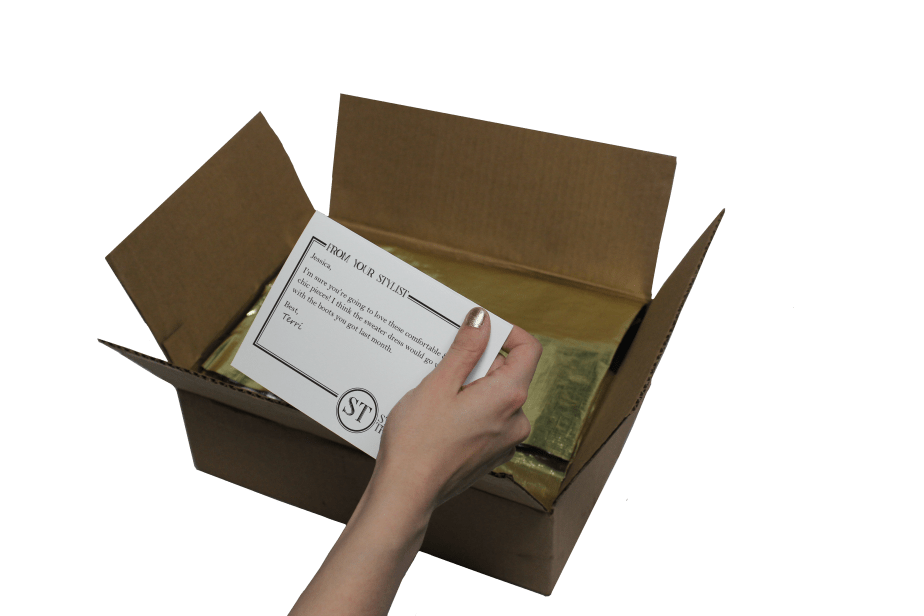
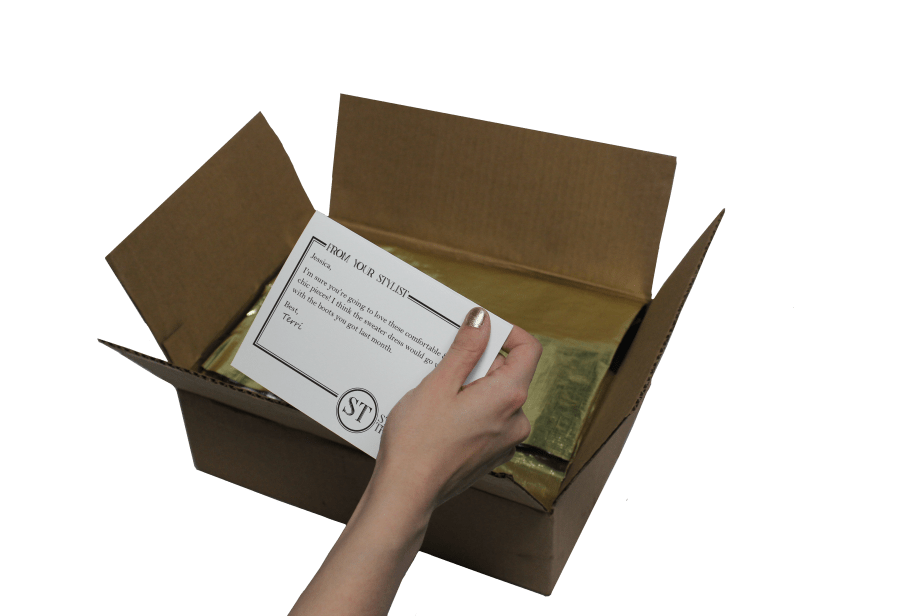
My “Stellar Threads” box mimicking the appearance of clothing subscription boxes.
First, why do people purchase personalized products? Based on 71 interviews conducted by Jie Zhen et al., people purchase personalized products for reasons including: uniqueness seeking, emotional attachment, identity expression, enjoyment, vanity, innovation, ownership, and perceived control (Zhen et al., 18). These motivations can easily be used to a company’s advantage by creating personalized products that appeal to customers’ desires. Stitch Fix sells the idea of a lifestyle with unique expression and free will over one’s appearance and perceived capabilities and personality. “Fashion products have social and symbolic aspects, so people need reassurance about their fashion choices, which influence their acceptance and belonging in the group,” (Le Bon, 49). In general, people are very open to buying personalized products for themselves because having unique items helps build an identity and image for a certain place in their social structure. The persuasive appeals of unique identity and independence are used in the detailed personality and style quiz that helps decide what kinds of clothing will be sent to customers. Choosing between general style types, colors, and clothing features gives customers the perception of many categories and that their choice lead to a unique endpoint. “This “mere categorization effect” occurs by increasing choosers’ perceptions of variety, which increases their feelings of self-determination,” (Mogilner et al., 203). Having the option to return products and essentially undo purchase decisions greatly increases chances of consumers buying personalized products for themselves or as gifts (Choi et al., 520). People may scoff at the idea of letting a stranger pick out clothes for them, and not seeing the clothing until they are delivered. Clothing can vary in size from brand to brand, so it can be much easier to buy in person to get the right sizes. Stitch Fix has a free return policy, which takes away the members’ risk of being stuck with clothes or accessories they do not like. In fact, a Stitch Fix delivery can be entirely returned, so there is minimal risk of unwanted products. (However, the $20 ‘styling fee’ is kept until it can go toward a different item the member decides to keep.) There is an additional incentive of 25 percent off the entire box if all items are kept, so people can be persuaded that they are getting a better deal and a full outfit at the same time. Boxes can be ordered individually or at scheduled times, giving members even more freedom and independence in the buying process. This sense of control is attractive to customers and adds to the idea that they are getting a great deal for a worthwhile service.
One might argue that it makes more sense to shop for oneself instead of paying for a stylist to do it. The fashion industry has constantly changing trends and styles, so it makes sense that personalized shopping services have emerged as a way for the average person to keep on top of trends without spending too much time and energy researching. According to Caroline Le Bon’s book on the fashion market, the adoption of new styles follows the wealthy in cycles as different social groups use fashion to visually distinguish themselves. It becomes cyclical because the wealthy continue to quit certain styles and turn to new ones to look different from those copying expensive fashion. Le Bon writes, “The desire to be viewed as wealthy or equivalent to the higher economic class justifies this imitation,” (9). Keeping up with fashion and appearing more wealthy, successful, or professional is one of the major reasons to have a stylist or use a program like Stitch Fix, Trendy Butler, Sprezza, Trunk Club, Le Tote, and more personalized clothes-shopping services popping up in the flourishing fashion industry. Another reason this type of service is successful is due to the lifestyles associated with the brands sold.
People who use the higher-end, more expensive clothing services are typically business professionals who want to appear stylish and successful. Trendy clothing hand-picked by stylists tends to make the wearer more confident, especially when celebrities are using the same program. Stitch Fix distributes many brand-name clothing items and using recognizable brands “can help people communicate a sense of self-worth,” (Ahmad, 2451). Positive association with both rich celebrities and hardworking professionals appeals to a wider range of customers than celebrity endorsements alone. Stitch Fix often quotes customers articles and social media posts, showing customers that an average person can save time and money by using this product—and that the visual change of new clothing translates into vocational success and respect from peers.
Their media strategy is strategically telling stories of people transforming their lives and careers, saving time and money, and feeling more confident and expressive through their fashion choices. These positive features increase chances of customer satisfaction, which increases customer loyalty (Ahmad, 2451). Using narratives in the form of promoted content or re-posted customer testimonials is a great example of narrative persuasion. “Narrative persuasion is a message strategy to influence beliefs, attitudes, and behaviors through stories,” (Cho et al., 829). Narrative persuasion, when done right, can be powerful. If the audience connects with the narrative and recognizes aspects of their own lives reflected in the story, they will be impacted by the message. This is why it is a smart move to share customers’ posts with glowing reviews of fun, stylish clothing. Seeing regular people using this specialized service and having positive experiences gives Stitch Fix’s claims more credibility than promoted posts alone. “The more the audience perceives the character and the events involving the character as real, the greater the likelihood of identifying with the character,” (Cho et al., 833). It is important to keep in mind that customers need to be shown how using this service will bridge the gap between their current lives and their ideal lives which they hope will mirror the lifestyle of the wealthy and famous. This middle step is shown in happy Stitch Fix members using the shopping service to look and feel great—something other consumers recognize and want to join.
Promoted content about the service is another way to get a specific message to the public, but a study by Hanusch et al. discussed how the public can be rather suspicious of sponsored content. It is more difficult to be persuasive with sponsored content than organic word-of-mouth because sponsored messages are sometimes doubted as credible or reliable. When an audience doubts the motivations of a message source, the message is lost or misunderstood, potentially triggering reactance in the audience. “It may be that the degree to which a persuasive message threatens recipients’ positive and negative face wants influences subsequent resistance behaviors, such as message and source derogations and postmessage attitudes,” (Jenkins and Dragojevic, 562). Both businesses and journalists have to be careful when working on promoted content, because if audiences think a positive review was written only for money, that will hurt the business’ reputation more than the absence of a positive review. Interviews of 89 journalists from multiple countries found that most journalists who also worked in PR were “merging both roles, downplaying their PR activities, or disclaiming their responsibility for engaging in PR due to financial issues,” (Hanusch et al., 150). Many journalists in the fashion or lifestyle sector are given promotional items or sponsored for certain articles, which can bring up questions about bias and even cause the intended message to backfire. According to many of the interviewed journalists, they are pressured to maintain positive consumption-centric stories in the lifestyle section that is not expected of business or political stories (Hanusch et al., 154). The lifestyle journalists that present news about products and services are expected to maintain honesty, and whenever readers suspect otherwise, their source-receiver relationship is threatened. Politeness theory “characterizes resistance to persuasion as a defensive reaction to an unjustified relational claim,” (Jenkins and Dragojevic, 560). This negative reaction can happen whenever a message’s source assumes too much power or superiority over recievers.
Knowing that customers prefer a certain type of implied relationship in communications is helpful, but how do companies take advantage of this to word their advertisements? Stitch Fix aims for a friendly, near-equal power footing in communications. Many white papers released by Stitch Fix give advice on seasonal wardrobes or address certain issues with clothing relatable to many consumers. Elena Stephan et al. in their article “Politeness and Psychological Distance: A Construal Level Perspective,” studied how polite language in a message reflects and/or creates a social and psychological distance between the sender and receiver. On one hand, using polite language shows respect and makes the audience more likely to agree to requests, but overly polite language throws up a social and psychological barrier, making the two parties seem far-removed and the original message becomes less relevant to the intended audience (Stephan et al., 270). Once consumers perceive a company to be in separate social sphere that has little in common with their lives, it can be very difficult to rebuild an image that consumers identify with. Stitch Fix’s fashion articles are a solid example of messages that are overtly helpful and come across in a positive way. These articles are shared on social media and are promoted to catch more viewers’ attention. Instead of an annoying barrage of informercials, the articles are more like fashion news that merely happens to come from Stitch Fix.
Overall, Stitch Fix uses both logical and emotional appeals to sway consumers to use their service. The logical appeals include the convenience of saving time, money, and effort on clothes shopping. Other logical appeals are the very popular free shipping and free returns features, making the purchases seem completely independent and optional. Stitch Fix uses narrative persuasion and polite message encoding to get customers to feel like a part of a group when they become members of the service. These more emotional appeals make customers more likely to remain customers. Stitch Fix is selling a lifestyle of fashionable, popular, and successful people who are enhancing their lives with personalized shopping. Customers want to feel like they too can be more popular and attractive, and visual transformations are often an effective way to display social rank and influence. While some may prefer to shop for themselves, Stitch Fix is an attractive option for people looking to belong with the popular, stylish crowd.
Sources:
Ahmad, Amir. “Evaluation of the Relationship between Brand Measures and Customer Satisfaction by Using Data Mining Techniques.” Journal of Intelligent & Fuzzy Systems, vol. 33, no. 4, Oct. 2017, pp. 2451– 2462.
Cho, Hyunyi, et al. “Perceived Realism: Dimensions and Roles in Narrative Persuasion.” Communication Research, vol. 41, no. 6, Aug. 2014, pp. 828–851.
Choi, J., et al. The Influence of Purchasing Context and Reversibility of Choice on Consumer Responses Toward Personalized Products and Standardized Products. Psychological Reports, vol. 118, no. 2, 2016, pp. 510–526.
Festinger, Leon, and James M. Carlsmith. “Cognitive Consequences of Forced Compliance.” The Journal of Abnormal and Social Psychology, vol. 58, no. 2, 1959, pp. 203-210.
Hanusch, Folker, et al. “‘How Much Love Are You Going to Give This Brand?’ Lifestyle Journalists on Commercial Influences in Their Work.” Journalism, vol. 18, no. 2, Feb. 2017, pp. 141–158.
Jenkins, Mikayla, and Marko Dragojevic. “Explaining the Process of Resistance to Persuasion: A Politeness Theory-Based Approach.” Communication Research, vol. 40, no. 4, Aug. 2013, pp. 559–590.
Le Bon, Caroline. Fashion Marketing : Influencing Consumer Choice and Loyalty with Fashion Products, Business Expert Press, 2014. Mogilner, Cassie, et al. The Mere Categorization Effect: How the Presence of Categories Increases Choosers’ Perceptions of Assortment Variety and Outcome Satisfaction, Journal of Consumer Research, vol. 35, no. 2, 1 August 2008, pp. 202–215.
How often have you heard that something is being saved for a rainy day? How often have you purchased or planned something for a special occasion, and never actually got around to that plan? It fills everyday life with waiting for a special occasion. This implies that most days aren’t special, and that they aren’t worth much. My advice – don’t dull down your life by waiting around for a rainy day or special occasion.
One example that many people can relate to is the idea of a china cabinet at a relative’s house. This china cabinet is full of fancy dishes that never get used. Perhaps one holiday a year is deemed important enough for these fragile heirlooms to see the light of day. What’s the point of owning something that you don’t use? It just collects dust. At my family’s house, we started using the “fancy” china year-round about two years ago. At first, we would carefully navigate the kitchen cupboard to use other dishes, or very gingerly carry the china to the table. We use it all the time now, and sometimes it makes a regular meal seem a little more special.
Another example of something that almost never gets used is a sequined t-shirt I own. I got it about 2 years ago during some medical treatments for post-concussion syndrome. I had been in 24-hour pain for just under a year at that point. I distinctly remember thinking, “I’ll wear this when I’m happy enough.”
I guess I expected to get better within a few months and that I could wear the sparkly “pocket full of sunshine” shirt in celebration. That … didn’t happen. No medical treatment or medicine or physical therapy made a dent in my chronic pain. Eventually, I decided to wear the shirt because I liked it & it would brighten up my day. I was right. I still don’t wear that shirt very often, but at least it’s not sitting in my closet completely unused.
Have you been saving something for a special occasion or milestone? It’s great to set goals and celebrate achieving them, but make sure you aren’t just delaying celebrations to the point that they fizzle out. Make a normal day a special occasion with the things (and people!) in your life that you might not always make time for.
Especially during the past few months, people have been cooped up in their houses, waiting for normal life to resume. It is very easy to let days blend together. Without unique experiences to differentiate between regular days and holidays, without variety, existence can become pretty dull. Look for ways to build some variety into your routine, whether that is listening to new music, taking a different route when walking the dog, having a movie night, or trying new recipes.
Even though life might feel full of waiting for the next big event or achievement, there are still plenty of milestones along the way to recognize and celebrate. You can elevate an ordinary day by using the outfit/recipe/candle/decorations you’ve been saving for a special occasion. Don’t wait for a rainy day.
Back in the fall of 2018, I decided to try a new event at an upcoming forensics competition. (This is the college-level speech competitions kind of forensics, not CSI forensics.) I had never tried the Impromptu Speaking event, but figured it would be fun to try it out.
Planning a Speech in 2 Minutes or Less
In the impromptu speaking event, speakers must:
Base a speech around a quote
Have a structured speech with an intro, main points, and conclusion
Write and perform the speech in under 7 minutes
Aim for speaking around 5 minutes (or as long as possible without going overtime)
I had heard that the speech prompts at the Bowling Green State University meet would be all about space, so I was very excited. I was looking forward to slipping in as many Star Trek references as I could. I researched and felt ready to talk about SpaceX, NASA, lunar colonization efforts, or whatever else came my way. One space-related term I was sure I could relate to any speech prompt was the Overview Effect.
The Overview Effect is a psychological phenomenon astronauts experience when they see Earth from space. Author Frank White coined the term with his 1987 book, “The Overview Effect.” In Episode 107 of “Houston We Have A Podcast,” host Gary Jordan and Frank White talked about how White came up with this concept. White explained, “…the first thing that most people think about when they think about the overview effect is no borders or boundaries on the Earth. And we know that. But we create maps that show borders and boundaries. … it’s knowing intellectually versus experiencing it.” It’s more than just realizing that humanity is united across arbitrary map borders. The mere wisp of atmosphere around the Earth floating in the endless void of space brings home how precarious and valuable life is. After experiencing being in space and getting a unique perspective, astronauts realize that humanity is connected in a way that is hard to explain.
This catch-all interconnectedness was a great concept to fall back upon during the speech competition. As long as I could think of a few other relevant points, I could bring it together with this encompassing philosophy of the overview effect. Then, to my surprise, I learned that the event was not in fact space-themed.
Ah, the buzzing energy and frenetic pace of piecing a meaningful speech together in mere moments. It’s such a fun challenge! One prompt was an Elton John lyric, and another was a pseudo-deep statement about choosing our monsters. I spoke about J. K. Rowling’s writing process and dementors without ever reading a single Harry Potter book, but had heard enough pop culture commentary to understand. I made an off-hand comment about seeing life through rose-colored glasses, then laughed out loud when I remembered I was wearing actual rose-colored glasses! With pop culture references and drawing from my own life experiences, I was able to connect with my audience and create something real out of a sentence on a scrap of paper. For each round’s prompt, I rounded out my speeches with the overview effect. It lended weight to the performance and helped bring the various points together into a finished product.
This entertaining experience at Bowling Green State University proved that there is no substitute for preparation and practicing speech material. I should have done my own research to determine whether the competition would have been space-themed, but it was not a problem in the end. I knew my space-themed subjects well enough to relate them to truly random quotes. In a way, this proved the ‘interconnectedness’ premise of the overview effect.
To hear the whole Houston We Have A Podcast episode or to read the transcript:














 Sarah Turek Productions